

How to Set Up a Food Trailer Franchise Business in New Zealand
For many food trailer owners, the original goal is simple: build one successful mobile food business. But once the concept proves itself, a much bigger opportunity emerges. Instead of selling more food personally, the business can grow by selling a proven system to others. That is where franchising comes in.
In New Zealand, food trailers are particularly well suited to franchising. They require less capital than traditional hospitality sites, can be deployed quickly, and are far easier to standardise across regions. When done properly, a food trailer franchise can scale faster and with less risk than bricks-and-mortar models.
Prove the Business Before You Franchise It
Before franchising is even considered, the original food trailer must already be working consistently. This means it needs to be profitable across different trading conditions, simple enough to operate without the founder present, and resilient to changes in location or staffing.
If the success of the business depends heavily on the original owner being on site, the concept is not ready for franchising. The model must be refined until it can be replicated by someone else with training and systems rather than instinct.
At this stage, many operators start thinking seriously about standardising their setup. Moving to a consistent trailer build and layout helps remove variability and makes it easier to assess whether the concept truly works as a repeatable business.
Standardising the Trailer Is Essential
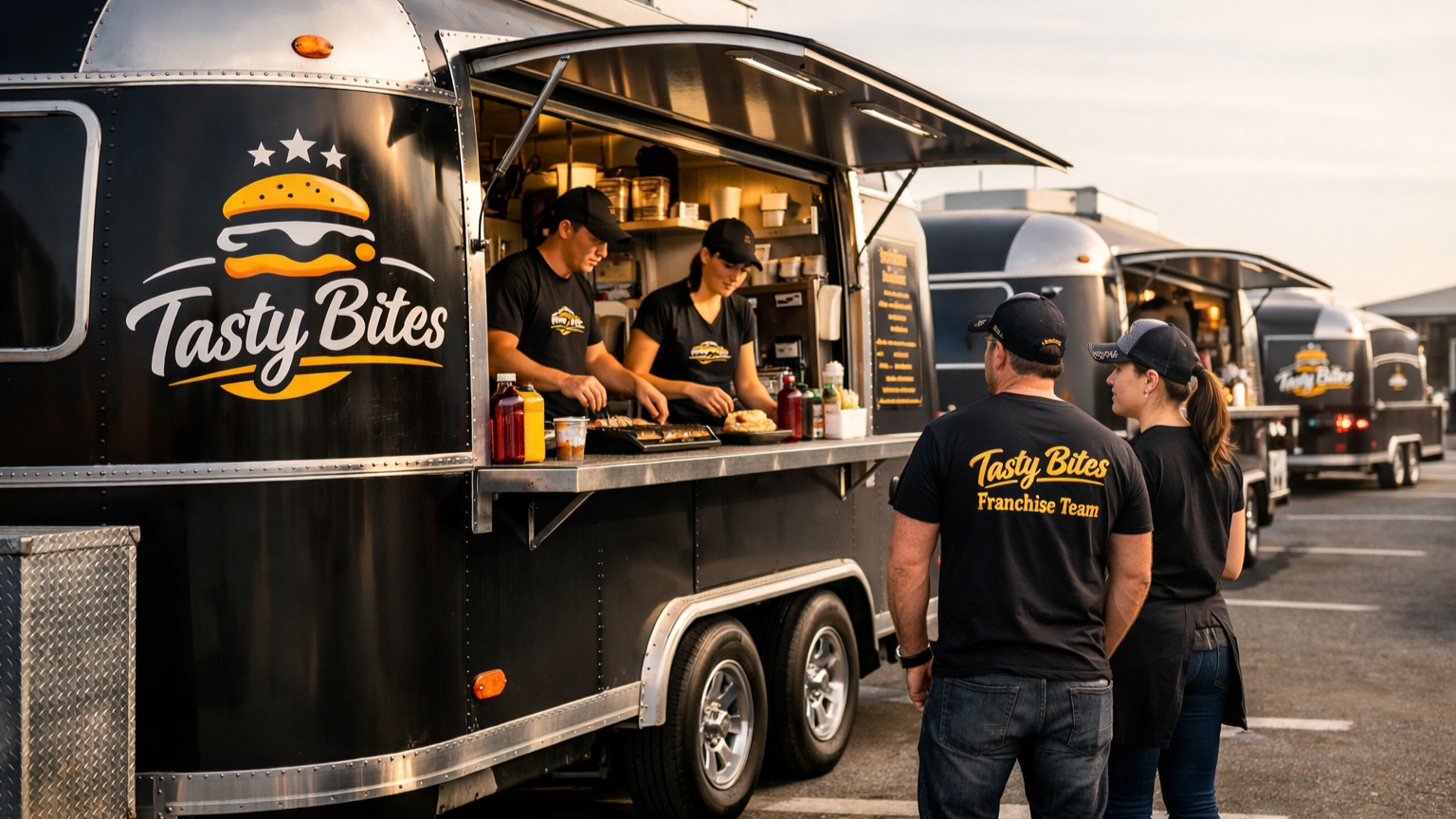
In a franchise model, the trailer itself becomes the franchise unit. If every trailer looks or operates differently, the brand quickly loses control. Inconsistent layouts lead to inconsistent service, uneven food quality, and compliance headaches.
Successful food trailer franchises treat the trailer as a fixed asset with a defined specification. The layout, equipment placement, power requirements, and service flow should be identical across all units. This ensures that training is easier, maintenance is predictable, and brand standards are maintained everywhere the business operates.
This is where experience matters. We have worked with franchisors to develop standardised trailer platforms that are designed specifically for multi-unit rollout. These platforms allow brands to grow without redesigning or re-engineering every time a new franchisee comes on board. Get in touch with our experience team to find out how we can have birng to life your dream
Designing a Menu That Can Be Franchised
A menu that works for a single owner-operated trailer is not always suitable for a franchise. Franchise menus must be designed for repeatability rather than creativity. They need to be easy to execute, fast to serve, and forgiving when staff turnover occurs.
The most successful franchise menus are tightly focused. They rely on a small number of core items, shared ingredients, and clearly defined preparation methods. This reduces training time and minimises the risk of variation between locations.
Menu design and trailer fit-out must be developed together. From our experience working alongside franchisors, this alignment is one of the most common points of failure when it is overlooked early. Getting it right upfront avoids costly changes once multiple units are already in the field.
Systems Matter More Than the Food
Franchising is not about selling trailers or recipes. It is about selling systems. A franchisee is buying certainty, support, and a clear way to operate a business.
This requires documented processes for daily operations, food safety compliance, supplier sourcing, pricing guidance, and brand presentation. In New Zealand, where council requirements vary by region, these systems must also be flexible enough to adapt without losing control.
Making Sure the Numbers Work for Franchisees
One of the most common reasons food franchises fail is unrealistic economics. A franchise model only works when franchisees can make a reasonable return after fees, costs, and downtime are accounted for.
Food trailer franchises have a major advantage here. Startup costs are typically far lower than fixed-location hospitality businesses, and overheads are easier to control. This makes it possible for franchisees to reach break-even faster, provided the model is structured sensibly.
Many franchisors choose to include the trailer as part of the franchise package. This approach helps control quality, simplifies financing discussions, and ensures every unit meets brand and operational standards from day one.
Protecting the Brand Through Visual Consistency
In a franchise, visual consistency builds trust. Customers should be able to recognise the brand instantly, whether the trailer is operating in Auckland, Tauranga, or Invercargill.
This consistency must extend beyond the logo. Trailer finishes, signage placement, menu boards, staff uniforms, and even social media imagery should follow clear guidelines. When these elements are aligned, the brand appears established and professional, even in its early stages.
Franchisors we work with treat the trailer as a core brand asset, not just a kitchen. That mindset is one of the strongest indicators of long-term franchise success.
Scaling Gradually Reduces Risk
The most successful food trailer franchises in New Zealand scale in stages. They often start by operating a second company-owned unit, followed by a pilot franchise. This allows systems to be tested and refined before a wider rollout begins.
Trying to launch multiple franchises at once often exposes weaknesses in training, support, and operations. Scaling gradually gives the franchisor time to fix issues while the brand is still manageable.
A modular and standardised trailer platform makes this staged growth far easier and far less risky.
Final Thoughts
Food trailer franchising is not a shortcut to growth. It is a structured, systems-driven way to scale a proven concept. When the foundations are solid, franchising allows food trailer brands in New Zealand to expand faster, with lower capital risk and stronger brand control.
The decisions made early — particularly around trailer design, menu structure, and operational systems — will determine whether the franchise becomes an asset or a liability.
If you are thinking beyond a single trailer and towards building a recognisable multi-unit brand, it pays to work with partners who understand franchising, standardisation, and long-term rollout from experience. Talk to our team for more information on our trailers